

DIY Kitchen Organization for Renters: 2026 Guide
Table of Contents
- What You'll Need Before You Start Organizing
- No-Drill Kitchen Organization: Damage-Free Methods That Actually Work
- Removable Kitchen Cabinet Organizers Worth Installing
- Small Apartment Kitchen Storage Solutions for Tight Spaces
- Budget DIY Hacks Using Repurposed Items
- Pantry Organization and Inventory Management for Small Kitchens
- DIY Kitchen Organization Reversibility Checklist for Renters
- Conclusion
Last Updated: August 24, 2026
What You'll Need Before You Start Organizing
DIY kitchen organization for renters requires working within lease constraints: no permanent holes, no surface damage, and everything reversible when you move out.
At Colons Home, we offer innovative kitchen solutions and smart home devices designed to make daily living more efficient and enjoyable. Before you buy a single organizer, spend 20 minutes doing this:
- Measure your cabinet interiors (height, width, depth). Older apartments often run smaller than standard organizer sizes.
- Photograph every surface inside cabinets, under the sink, and inside drawers for reference when shopping.
- Audit what you own. Categorize by daily use, weekly use, and rarely used. Daily items should live at eye level or countertop height.
- Note your surface types. Adhesive products behave differently on painted drywall, tile, laminate, and textured walls.
- Check your lease. Some leases prohibit even adhesive hooks.
The goal is a zone-based storage system: cooking zone, prep zone, coffee/breakfast zone, and cleaning zone. Grouping tools by task cuts down on frantic searching.
| Zone | Items to Include | Storage Priority |
|---|---|---|
| Cooking zone | Pots, pans, spatulas, oils | Stove-adjacent, eye level |
| Prep zone | Cutting boards, knives, mixing bowls | Counter or drawer access |
| Coffee/breakfast zone | Mugs, coffee maker, toaster | Dedicated countertop corner |
| Cleaning zone | Dish soap, sponges, sprays | Under-sink or cabinet door |
No-Drill Kitchen Organization: Damage-Free Methods That Actually Work
No-drill kitchen organization is not a compromise, it's a strategy. The best damage-free solutions are invisible when done right and leave zero trace when removed.
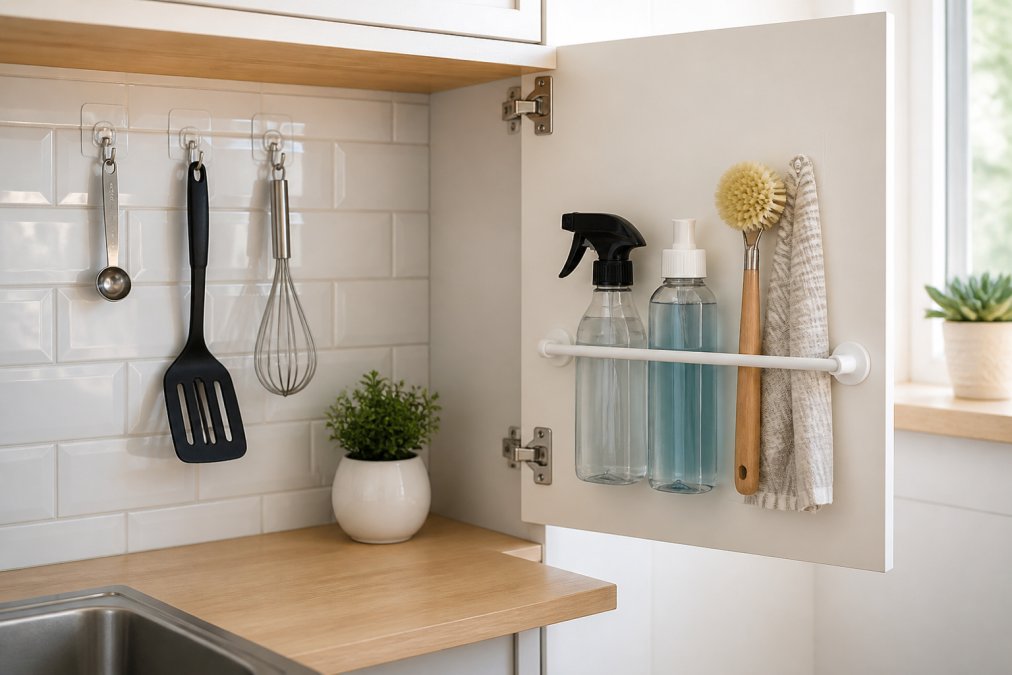
The biggest mistake renters make is treating adhesive products as permanent. They're temporary solutions, and that's exactly what makes them ideal for rented spaces.
Adhesive Hooks and Strips: Weight Limits You Need to Know
Adhesive hooks and strips are the backbone of no-drill kitchen organization, but most people ignore the weight ratings printed on the packaging.
According to the Consumer Product Safety Commission guidelines on adhesive products, weight ratings reflect ideal conditions: clean, smooth, non-porous surfaces at room temperature. In a kitchen, heat from cooking, steam, and grease residue all degrade adhesive strength over time.
Here's what the weight limits actually mean in practice:
- Rated for 1-3 lbs: Light items only, a dish towel, small utensil, lightweight cutting board
- Rated for 4-7 lbs: Medium items, a small pot lid, lightweight pan, grouped spice jars
- Rated for 8+ lbs: Heavier organizers, but only on tile or sealed surfaces, never on painted drywall
Always apply adhesive strips to a surface cleaned with isopropyl alcohol and allowed to dry for a full 24 hours before loading. Skipping this step cuts adhesive strength significantly.
Tension Rods: The Most Underrated Renter Tool
Tension rods deserve far more credit than they get. A single tension rod costs very little, requires no hardware, and opens up storage possibilities most renters never consider.
The most practical applications in a kitchen:
- Under the sink: Mount a tension rod horizontally to hang spray bottles by their triggers, freeing up the entire cabinet floor for bins and stackable containers.
- Inside deep cabinets: Use two tension rods side by side to create a DIY shelf for pan lids, baking sheets, or cutting boards stored vertically.
- Inside cabinet doors: A short tension rod holds a small basket or organizer without any screws.
- Across a corner cabinet: Span a tension rod across the interior to hang lightweight items or corral bags.
For spans under 18 inches, a standard rod works well. For longer spans, look for a rod with an internal spring mechanism rather than a twist-lock design.
Removable Kitchen Cabinet Organizers Worth Installing
The removable kitchen cabinet organizer market has expanded significantly. Here's how to choose well.
Shelf Risers and Stackable Inserts
Shelf risers are the single highest-impact purchase for most small kitchens. A standard cabinet has one fixed shelf, wasting the top half of vertical storage. A riser doubles your usable space without touching the cabinet itself.
Look for adjustable-width risers that fit your specific cabinet dimensions, non-slip feet to prevent sliding, and open wire or mesh construction for visibility. Stackable containers work on the same principle, letting you see every item at a glance and pull out the whole bin rather than digging to the back.
Cabinet Door Organizers and Drawer Dividers
Cabinet door organizers mount over the door edge with no screws or adhesive, holding an impressive amount without permanent modification. They work best for spice packets, aluminum foil and plastic wrap boxes, small cutting boards, and cleaning supplies.
Drawer dividers are the most underrated drawer upgrade available. Adjustable bamboo or plastic dividers turn a chaotic utensil drawer into a system where everything has a place. Measure your drawer depth carefully, many dividers are designed for standard-depth drawers, and shallower apartment drawers require a different size.
Small Apartment Kitchen Storage Solutions for Tight Spaces
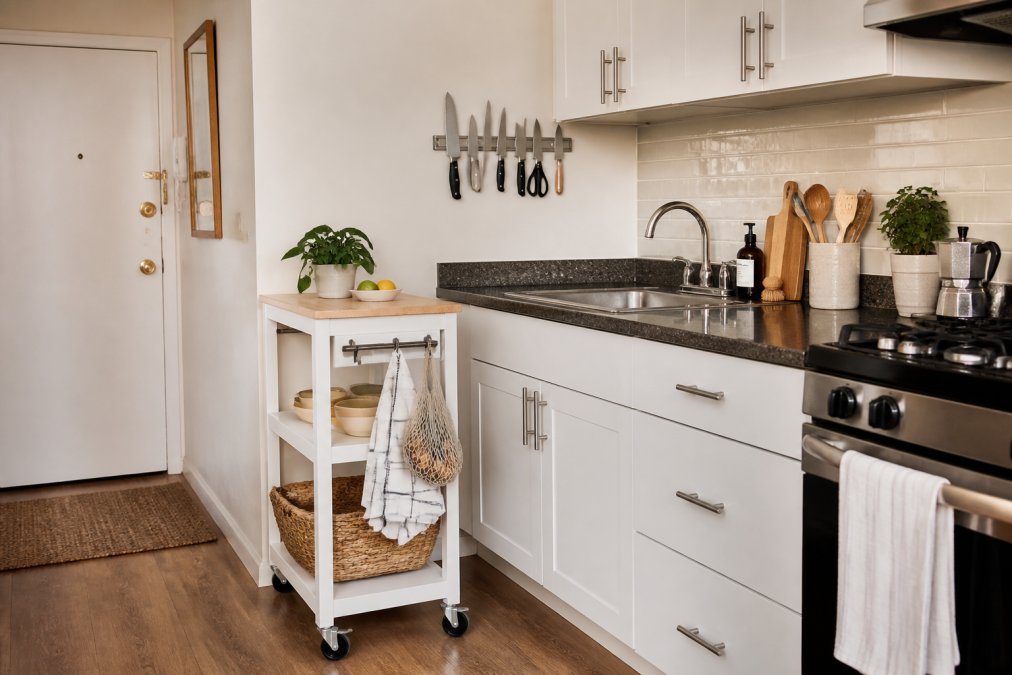
Small apartment kitchen storage solutions work best when they treat vertical space as the primary real estate. Most renters think horizontally about counter and cabinet space, but walls, door backs, and space above eye level are consistently underused.
Vertical Storage: Magnetic Strips, Over-the-Door Hooks, and Wall Space
A magnetic strip for knives and metal tools is one of the most space-efficient additions to any kitchen. Mounted on the wall, it removes a knife block from the counter entirely and keeps blades accessible and safely stored.
For renters, use a magnetic strip that mounts with heavy-duty adhesive rather than screws. These work reliably on tile and sealed walls. On painted drywall, use a strip light enough to stay within adhesive weight limits and check the bond monthly.
Over-the-door hooks on cabinet doors and pantry doors add significant storage capacity without modification. Individual hooks work for aprons, oven mitts, and reusable bags. A wire rack hung over the door stores pot lids effectively.
For wall space beyond the magnetic strip, a small pegboard panel hung with adhesive or a tension-mounted frame creates a customizable, modular system. As documented in the National Kitchen and Bath Association's kitchen design guidelines, maximizing vertical storage is a core principle of functional kitchen design regardless of square footage.
Utility Carts and Under-Sink Storage
A rolling utility cart is the most flexible storage addition available to a renter. It adds counter space, storage capacity, and mobility. Look for at least two shelves with appropriate weight ratings, locking casters, and a slim profile under 16 inches wide.
Under-sink storage is the most neglected space in most apartment kitchens. The plumbing creates an awkward layout, but targeted solutions fix it: use a tension rod to hang spray bottles, add a two-tier expandable shelf to work around the pipes, use stackable bins to organize cleaning supplies by category, and line the floor with a waterproof mat to protect against minor leaks.
Budget DIY Hacks Using Repurposed Items
The most creative small kitchen organization ideas come from looking at what you already own and asking what else it could do.
Practical repurposing ideas that actually work:
- Mason jars mounted under a shelf: Use adhesive-mounted lid holders. The jars hang down and hold dry goods, utensils, or small tools. Completely reversible.
- A tension-rod curtain rail as a pot rack: Hang S-hooks from a tension rod mounted between two walls or cabinet sides to create a hanging storage system for lightweight pots and utensils.
- Magazine files as vertical pan storage: Sturdy magazine files, stood upright in a cabinet, hold baking sheets, cutting boards, and pan lids vertically.
- A shower caddy as a sink organizer: A suction-cup or tension-mounted shower caddy at the sink holds dish soap, a sponge, and a scrub brush off the counter.
- Pegboard on a tension-mounted frame: A small pegboard panel held in place by a frame tensioned between the floor and ceiling creates a fully customizable, landlord-approved tool wall.
- Ice cube trays as drawer organizers: A standard ice cube tray in a drawer is an effective and free divider for small items like twist ties, rubber bands, or bag clips.
According to the USDA's food storage and pantry organization guidelines, keeping frequently used items visible and accessible reduces food waste and makes meal preparation more efficient.
Pantry Organization and Inventory Management for Small Kitchens
Pantry organization in a small apartment kitchen is less about aesthetics and more about knowing what you have. The real problem is invisible inventory. When you can't see what's there, you buy duplicates, forget about items until they expire, and waste money.
The fix is a clear container system combined with a simple inventory habit.
Setting up clear container storage:
- Transfer dry goods (pasta, rice, flour, sugar, oats, lentils) into clear, stackable containers immediately after purchase
- Label each container with the contents and the date it was filled
- Arrange by frequency of use: daily items at eye level, weekly items above or below, rarely used items highest
- Use a lazy susan on any deep shelf to bring back-of-shelf items forward without digging
Inventory management for a small pantry: A simple running list on the inside of a cabinet door works well. A piece of paper in a sheet protector, updated with a dry-erase marker, costs almost nothing. A zone-based pantry layout mirrors the zone-based kitchen system: baking supplies together, breakfast items together, canned goods together.
The Colons Home collection includes space-saving kitchen accessories designed specifically for small-footprint kitchens, including stackable and modular storage solutions that fit the kinds of tight spaces renters work with every day.
DIY Kitchen Organization Reversibility Checklist for Renters
Before you move out, every modification needs to come down cleanly. Use this checklist to verify that everything you've installed is genuinely reversible.
Reversibility checklist for renters:
- All adhesive hooks and strips removed using the pull-tab method (never peeled straight off, always pull at a low angle parallel to the surface)
- Adhesive residue cleaned with isopropyl alcohol or a product safe for the surface type
- Tension rods removed and any pressure marks on cabinet paint assessed
- Over-the-door organizers removed and door edges checked for paint scuffs
- Magnetic strips removed and wall surface inspected for adhesive residue
- Shelf risers and cabinet inserts removed and shelves wiped clean
- Utility cart removed from the space and any floor scuffs addressed
- Under-sink tension rods and bins removed and cabinet floor cleaned
- Drawer dividers removed and drawer interiors wiped
- All repurposed items (mason jar holders, pegboard frames) removed and surfaces inspected
Weight-bearing limit reference for adhesive solutions:
| Surface Type | Adhesive Reliability | Max Recommended Load |
|---|---|---|
| Ceramic tile (clean, smooth) | High | Up to rated weight |
| Laminate cabinets | Medium-high | Reduce by 25% |
| Painted drywall | Medium | Reduce by 40-50% |
| Textured or wallpapered surfaces | Low | Avoid adhesive solutions |
| Wood cabinets (sealed) | Medium-high | Reduce by 20% |
Even products rated for drywall can pull paint when removed if the paint is old, thin, or poorly bonded to the surface. Always test in an inconspicuous spot first and check after 48 hours before committing to a location.
As outlined in HUD's tenant rights and security deposit guidance, tenants are generally responsible for damage beyond normal wear and tear. Adhesive damage that pulls paint qualifies as damage in most lease agreements. Knowing your reversibility options protects your deposit.
Small kitchens reward systematic thinking more than big budgets. The renters who get the most out of their space are the ones who measure before they buy, zone their storage before they organize, and choose reversible solutions from the start. That approach costs less, works better, and leaves no trace when it's time to move.
Colons Home offers a curated collection of kitchen organizers, space-saving accessories, and smart home solutions designed to work beautifully in exactly these kinds of spaces. Shop Now to find the tools that make your kitchen work harder for you.
Frequently Asked Questions
How can I add storage to a small kitchen without drilling?
Tension rods, adhesive hooks, over-the-door organizers, and freestanding utility carts all add meaningful storage without a single hole in the wall. Tension rods work inside cabinets to hang spray bottles or create dividers. Command-style adhesive strips hold lightweight items up to around 7 pounds per strip when applied to clean, smooth surfaces. For kitchen organization renters rely on most, combining two or three of these methods across different zones gives the biggest storage gain.
What are some inexpensive ways to organize a kitchen?
Repurposed items cut costs fast. Mason jars corral dry goods on open shelves. A tension rod under the sink creates a hanging storage rail for cleaning bottles. Lazy Susans from discount stores turn deep cabinet corners into accessible space. Clear stackable containers for pantry staples eliminate duplicate purchases. Drawer dividers made from small cardboard boxes or repurposed trays keep utensils sorted. Most of these cost a few dollars and require no tools, making them ideal for renter-friendly kitchen organization on a tight budget.
How do I cover or update kitchen cabinets as a renter?
Removable contact paper is the most landlord-approved option. It applies smoothly to cabinet faces and interiors, peels off cleanly when you move out, and comes in dozens of finishes including wood grain and solid colors. Peel-and-stick wallpaper works on the same principle for the backs of open shelving. Always test a small hidden patch first to confirm the adhesive lifts without pulling paint. Avoid permanent adhesives, paint, or hardware that requires drilling, as these typically violate standard lease agreements.
What weight limits should I know before using adhesive storage solutions?
Most adhesive hook products specify a maximum load on the packaging, commonly between 3 and 7 pounds per hook for standard strips. Exceeding that limit risks wall damage and lost your security deposit. For heavier items like cast iron pans or a full magnetic knife strip, look for products rated at 10 pounds or more, and always apply them to smooth, non-porous surfaces that have been cleaned with isopropyl alcohol first. Never use adhesive solutions on textured walls, wallpaper, or fresh paint under 30 days old.
This article was written using GrandRanker